Angler numbers grow in Tasmania
The number of people going fishing in Tasmania has bucked a declining trend, with participation approaching a 20-year high, with youngsters playing a key role in rise.
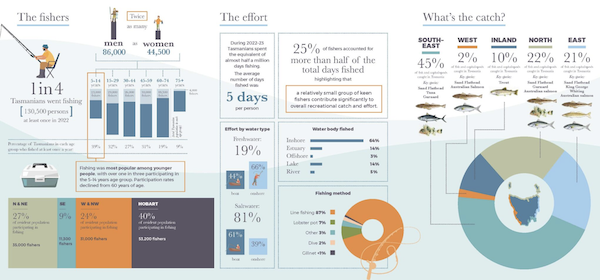
Researchers from the University of Tasmania’s Institute for Marine and Antarctic Studies (IMAS) say their latest recreational fishing survey, covering 2022/23, shows that 130,5000 – or around 27 per cent of the population – enjoyed the sport in the year up to October 2022.
It’s the fifth time the survey has been undertaken since 2000 and provides important insights into how many Tasmanians go fishing, how often and what they catch.
Despite the largest number of recreational fishers being in the 45 to 59-year-old age group, young people aged five to 14 had the highest participation rate, with one in three from the youngest age group fishing at least once a year.
Research fellow and report co-author Dr Kate Stark revealed: “The decline in participation reported since the year 2000 has turned around, with participation now close to that reported over 20 years ago.
“The biggest growth has been in the youngest age group, and it’s encouraging to see that more kids are getting outdoors and doing something away from technology,”
While participation rates have increased, the survey revealed that most fishers don’t fish often, with about two thirds picking up a rod less than five days per year.
Dr Stark added; “As an individual who doesn’t fish much, it can be easy to think you’re not having an impact. However, with 130,500 people in the state fishing, those individual actions add up.
“There were almost 500,000 fisher-days of effort expended in the 12 months from October 2022, and the vast majority of this was line fishing in inshore marine waters.”
Despite recreational fishing efforts remaining relatively steady over the last decade, harvest has decreased significantly, primarily because of a reduction in the number of sand flathead caught.
Even so, this was still the most caught species, making up 50 per cent of the total finfish catch, with an estimated 126 tonnes harvested.
- Log in or register to post comments