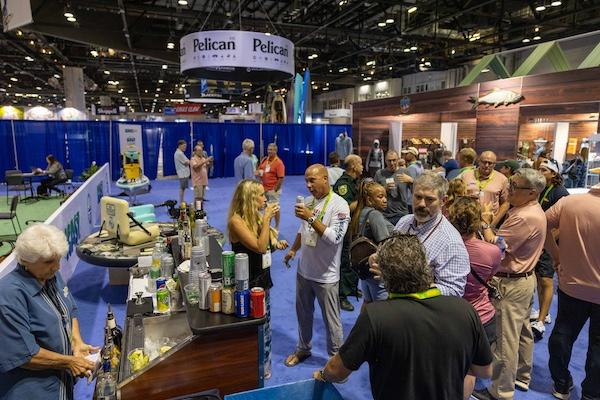
China Fish 2010 – the 20th anniversary of the rapidly growing trade event – has garnered a mixed reaction from visitors and exhibitors alike.
The show, which took place on February 23rd to 25th, saw a massive 509 exhibitors display their products to 2,157 buyers from 82 countries, meaning that visitor attendance was up 26.2 per cent on last year.
Despite increased attendance, many visitors and exhibitors said that the show felt smaller. We spoke with China Fish president, Mr Li Jiang, to find out more about this show, how it’s changed over the past 20 years… and more!
So why did people feel that the attendance was low?
It may be related to China Fish’s rapid expansion. This year the number of exhibiting companies was 14.3 per cent up on last year – and the exhibiting area was up 31 per cent to 35,000m2. There were 26.2 per cent more visitors – but to many the show felt quieter. Maybe this was because of the buyer/exhibitor balance?
According to our interviews with exhibitors, 72 per cent of exhibiting companies said there were fewer buyers visiting their booths than at last year’s show, and 61 per cent of companies told us that there were 30 to 60 per cent fewer visitors with purchasing plans, so maybe the economic crisis is finally beginning to exert its bad impact on China…
At China Fish 2009, people thought that the global economic slowdown couldn’t possibly affect the Chinese fishing-tackle industry, but today most people are feeling the effects.
Not only was there less ordering, but the orders were small, and on the third day of the show, only a third of visitors came to the exhibition while the rest visited factories or went to Beijing.
How has China Fish changed, and have exhibitors’ attitudes changed much over the past 20 years?
China Fish has changed from a domestic-oriented show to an international affair.
The show gets bigger and bigger, especially considering the amount of exhibitors this year.
Each year we get a more international interest. We’ve had buyers from more than 106 countries between 1998 and 2009.
China Fish is now trying to establish itself as a gateway for those international companies looking to enter the Chinese domestic market.
Chinese enterprises are improving. Ten years ago only low-end products could be seen at China Fish, but now more mid-range and even high-end products are exhibited at the show.
Do you feel that Chinese manufacturers are about to turn the corner and become full-blown brands? Is China Fish the exhibition to do this or is there a need for a new type of show?
Looking at the whole fishing-tackle industry in China, powder bait will be the most competitive and the most obvious product to build up a brand in overseas markets due to its unique developing background and business model.
The moment the Chinese bait industry started it was confronted with fierce competition from neighboring countries like Japan, South Korea and Taiwan. By surviving this competition the Chinese bait industry has built up its business model and is now primed to expand.
Such hopes and aspirations will only be fulfilled by the second generation’s creativeness. China Fish will fully support Chinese bait companies by helping them to compete in the global market.
Do you fear the emergence of other nations as manufacturing strongholds?
As far as I know, the production of low-end products like bags and fishing giftware has already shifted to Thailand and Indonesia. For other products, as long as the Chinese government maintains its business policies, I think nothing will change in the short term, since 80 per cent of fishing products are already made in China.
Thinking long-term, there is indeed a tendency for this shift. This issue is very complicated, though, and is down to manufacturing techniques, a nation’s policy and its economy.
We see many buyers around the world, but few of them attend China Fish every single year. Many come once, then miss a few years and then come again. Why do you think this is, and what can you do as China Fish organiser to ensure that the show is a must-attend event for the tackle trade around the world?
It’s different to EFTTEX and ICAST where companies release a number of new products every year; most big wholesalers come once, then miss a year. Buyers with small orders will stay in China for longer and make numerous contacts here, so they don’t need to visit China Fish each year either. But if OEM manufacturing is their main focus then surely they would visit China Fish every year.
It is worth noting that the number of new exhibitors has been increasing with 94 new exhibitors in 2010 who had never participated in China Fish before. And more importantly, the products exhibited by these companies are higher in quality.
To ensure a must-attend event we must strive to do the following:
What plans do you have for the next five years of the show? Do you see any changes in the format and the way the show is run?
Yes! We will launch a local-market-oriented hall or pavilion at China Fish 2011.
We have also decided to open up a separate hall or zone for exhibitors who are committed to domestic markets. Basically, most exhibitors come to China Fish to meet international buyers, but this zone is specially designed for international buyers who would like to enter the domestic market. In the next two or three years we will set the same exhibiting fee for both domestic and international exhibitors. I hope this proves to be a great success.
Why does the show have to keep moving?
Because the size of the show is increasing each year. Of course it’s better to have a fixed venue and this is something that we’re looking into…